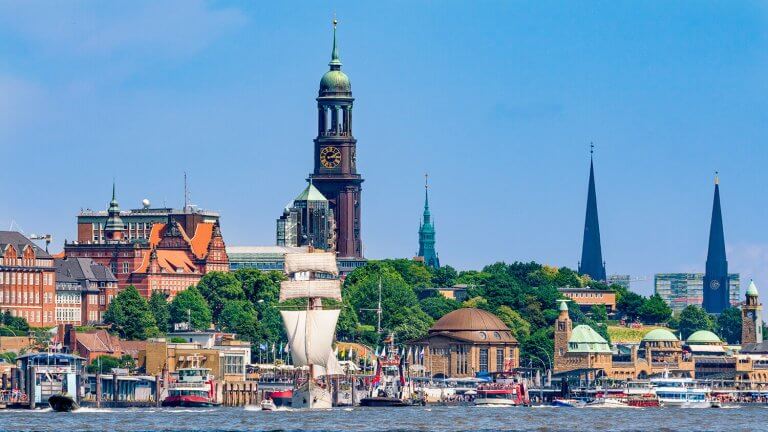
Hello there, fellow travellers.
I’m Sarah from Turbopass, and I’m genuinely excited to walk you through Hamburg’s public transport system – one that I’ve come to appreciate as among Europe’s most reliable and well-connected networks.
If you’re heading to Germany’s second-largest city, a bit of orientation goes a long way. In the very heart of Hamburg – between the Alster and the Elbe – many of the city’s major sights sit surprisingly close together. If you’re comfortable on foot, you can cover much of this area easily and get a real sense of the city along the way.
If you prefer to move a little faster, take a short break between stops, watch the world roll by from your seat, or reach places further from the centre, Hamburg’s public transport network is an ideal companion. Operated by the Hamburger Verkehrsverbund (HVV), it’s extensive, reliable, and refreshingly straightforward. What’s especially convenient is how well everything connects: you can ride an S-Bahn from the airport, switch to the U-Bahn towards the city centre, cross the Elbe on a harbour ferry, and finish your trip on a bus – all with just one ticket.
The first tip for your visit to Hamburg therefore concerns planning: find accommodation near a public transport stop. This is the most conventient feature you can ask for.
In this guide, I’ll share everything you need to confidently navigate public transport in Hamburg, from understanding the HVV fare zone plan to knowing which lines get you where you need to go. Whether you’re commuting from the airport to your hotel, heading to Miniatur Wunderland, or exploring the harbour, you’ll finish this article equipped with all the knowledge you need to travel like a local around Hamburg.
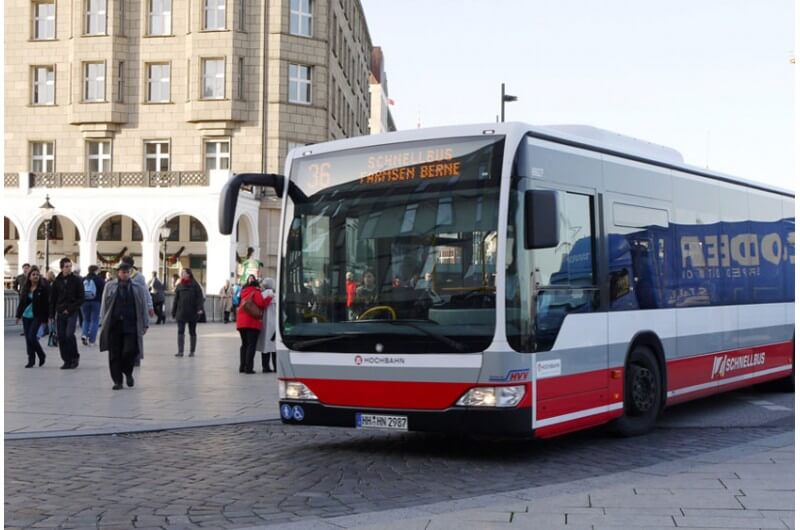
Hamburg’s HVV network encompasses approximately 930 kilometres of track and serves 289 train stations across various transport modes. The beauty of this public transport network is its integration – a single ticket grants you access to U Bahn underground trains, S Bahn suburban trains, regional trains within the system, city buses, regional buses, and HADAG harbour ferries.
Hamburg’s fare structure is based on geographical zones rather than the number of stops you travel. The HVV fare zone plan divides the metropolitan area and surrounding regions, including parts of Schleswig Holstein, into different zones. For most visitors, you’ll only need to understand two zones:
Zone A (Inner City): Covers Hamburg’s central districts including Hauptbahnhof (central station), HafenCity, Speicherstadt, St. Pauli, and Sternschanze
Zone B (Greater Hamburg): Extends to outer districts and Hamburg Airport
A ticket for zones AB covers nearly all tourist attractions and typical visitor destinations. The practical advantage: you can take as many stops as you wish within your paid zones – a journey of two stops costs the same as ten stops within the same zone boundaries.
Did you know? Hamburg’s public transport carries approximately 1.2 million passengers every single day, with a reliability rate consistently exceeding 95% – meaning delays are genuinely rare.

Note: Fares are subject to change. Always check the Onlineshop or the HVV App for the most current pricing.
Most important: Unless you have a pre-purchased city pass (like the Hamburg CARD or the Hamburg City Pass), you must buy a ticket before boarding.
For most travellers visiting for a few days, these are your best options found in the “Einzel- / Tageskarten” (Single / Day tickets) section:
Single Tickets: Valid for one journey in any direction, including transfers.
Day Tickets: Valid from validation until 6:00 AM the following morning. These are generally cost-effective if you plan to make 3 or more journeys in a day.
Group Day Tickets: Exceptional value for families or small groups (up to 5 people).
Hamburg Card: Combines unlimited public transport with admission discounts to over 150 attractions. Unlike the Hamburg City Pass, which offers free admission, the Hamburg CARD focuses on providing discounted entry fees.
For visitors planning to visit multiple paid attractions, the Hamburg City Pass offers a comprehensive “all-inclusive” solution. Unlike standard transport tickets, this pass grants free admission to many of Hamburg’s top sights, museums, and attractions – such as the Cap San Diego and the St. Michaelis Church tower. Crucially, the pass includes an HVV travel card, providing unlimited access to all U-Bahn, S-Bahn, buses, and harbour ferries within the AB area (Greater Hamburg) for the duration of the pass (1 to 7 days). It is an excellent option for travellers who want to combine heavy sightseeing with the convenience of a single ticket for all transportation.
You will see the hvv Deutschlandticket promoted heavily on the hvv website. This is a monthly subscription valid for all local transport across Germany. While excellent for locals or long-term travellers, for a short city break, the Day Tickets or Hamburg Card usually offer better flexibility without the need to manage a subscription.
The HVV App
The easiest way to travel is by downloading the standard HVV App (available on Google Play and iOS). You can purchase tickets directly on your smartphone, and they validate automatically.
Tip: The website also lists the hvv switch App. This app includes “new functions” like booking car-sharing or scooters. It’s a great alternative if you plan to use those modes, but for pure public transport, the standard HVV App works perfectly.
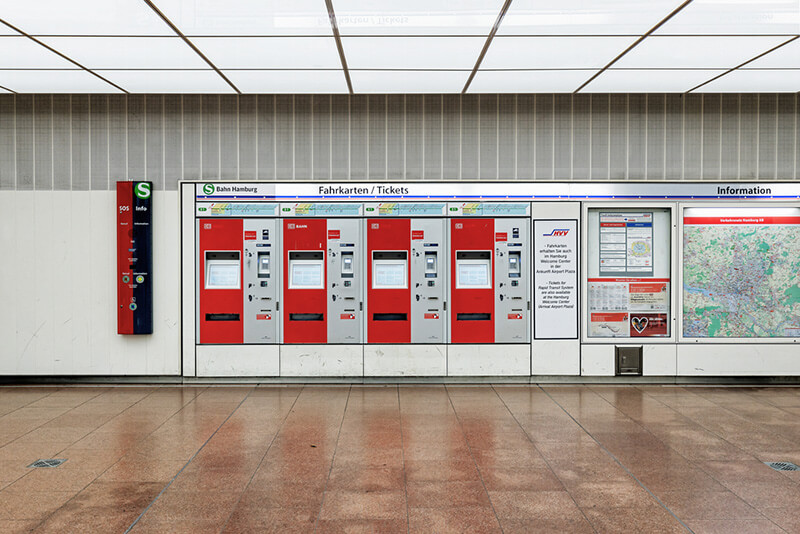
Ticket Machines
Available at all U-Bahn and S-Bahn stations. They accept cash, EC cards, credit cards, and contactless payment.
Onlineshop
You can also purchase tickets via the HVV Onlineshop if you prefer to arrange them before you leave your hotel.
Penalty
The fine for travelling with an invalid ticket is 60.00 EUR. Plain-clothes inspectors check regularly.
From extensive experience advising travellers, I can assure you the 60 EUR fine genuinely stings, particularly when a valid ticket would have cost under 4 EUR.
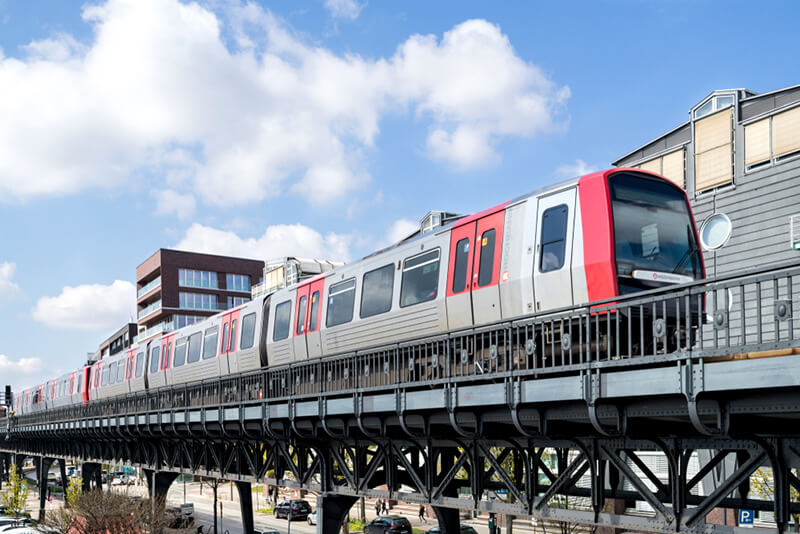
Hamburg’s U Bahn metro comprises four colour-coded lines serving 93 stations across the city centre and inner districts. These underground trains run predominantly below ground in central areas, emerging to elevated or surface tracks in outer districts.
Hamburg’s U-Bahn metro comprises four colour-coded lines serving the city centre and inner districts.
U3 (Yellow Line): Your Primary Tourist Line. Stops include Landungsbrücken (Harbour), St. Pauli (Reeperbahn), Sternschanze, and Rathaus.
U1 (Blue Line): Connects Jungfernstieg (Alster lake) and Hauptbahnhof.
U4 (Cyan Line): The HafenCity Connection. Connects the city centre to the Elbphilharmonie and Miniatur Wunderland.
U2 (Red Line): Ideal for families and nature lovers. It connects the city centre directly to the famous Hagenbeck Zoo (Tierpark Hagenbeck) and the Niendorfer Gehege (local recreation area) and the Messehallen trade fair grounds.
Navigation Tip: Each line is colour-coded, and platforms display large overhead signs indicating the line number and terminal destinations. You must know which direction you’re travelling – platforms are separated by direction. A transport map is available at all stations and in the HVV App.
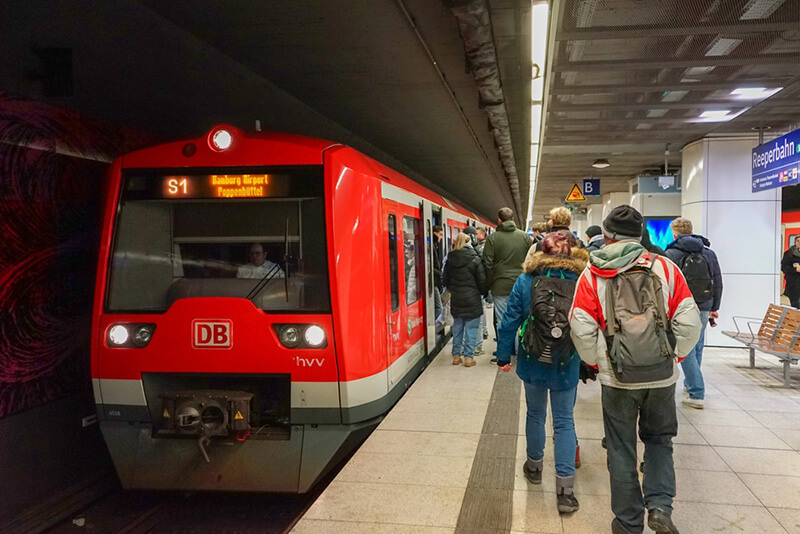
While the U Bahn focuses on inner-city connections, Hamburg’s S Bahn excels at linking the city centre with Hamburg Airport, suburban areas, and regional destinations.
Route: Hamburg Airport ↔ Hauptbahnhof ↔ Landungsbrücken ↔ Altona.
Time: Approx. 25 minutes from Central Station to the Airport.
Location: Follow “S-Bahn” signs from the arrivals hall.
Station Location at Airport:
The S Bahn station at Hamburg Airport connects directly to Terminals 1 and 2 via covered walkways. Follow “S-Bahn” signs from the arrivals hall – the walk takes approximately 3-5 minutes. This location makes the transition from airports to city transport seamless.
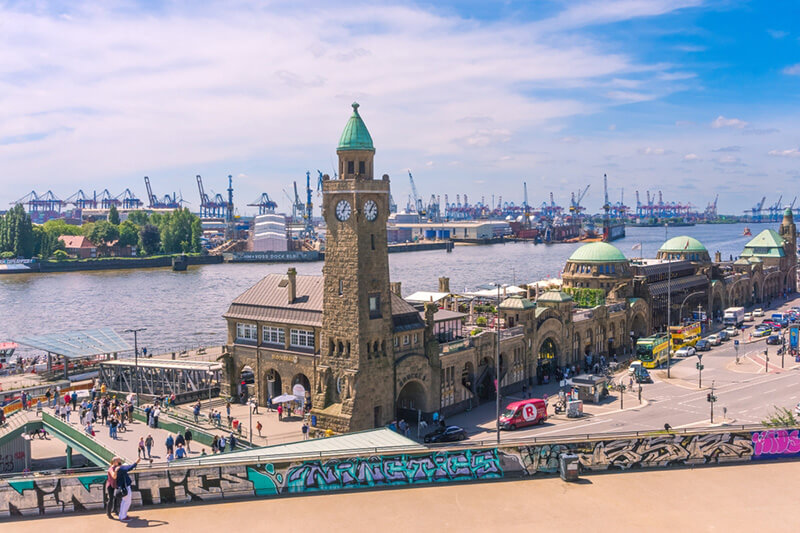
Route: Pinneberg ↔ Hauptbahnhof ↔ Landungsbrücken ↔ Southern districts
Key Stations:
Major Interchange Stations:
Hauptbahnhof (central station): All S Bahn lines connect with all four U Bahn lines
Jungfernstieg: S Bahn connects with all U Bahn lines
Landungsbrücken: S1 and S3 connect with U3 and the ferries
For journeys to other cities in Schleswig Holstein and beyond, regional trains also operate through Hamburg’s main train stations using the same ticketing system within the HVV zones. These regional trains connect Hamburg with nearby destinations and are valid with appropriate zone tickets.
Important Travel Advisory: Regional Trains
If you plan to take regional trains (e.g., toward Berlin or Lübeck), please check the “Aktuelle Meldungen” (Current Reports) on the HVV website or app. There are currently reports of “DB Sperrung HH-Berlin” and general renovation works (“Generalsanierung”) which may affect schedules. Until 2035 major rail corridors will undergo full multi‑month closures for extensive upgrades, affecting long‑distance train travel.
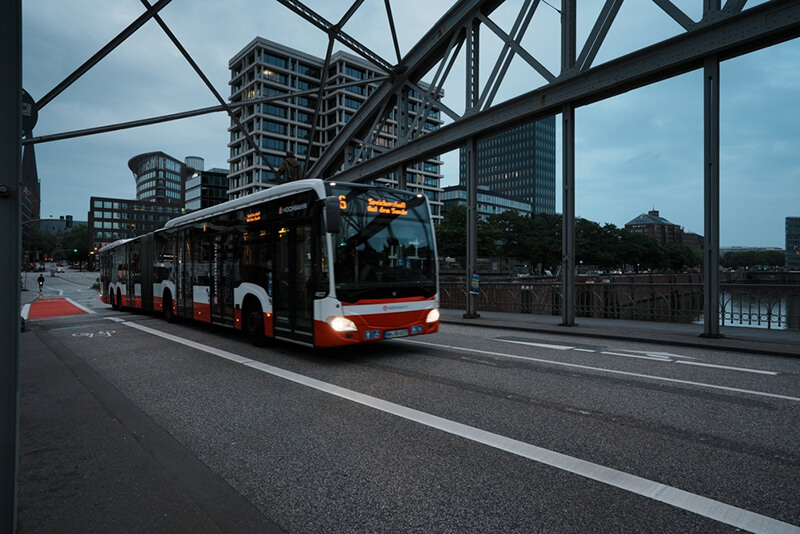
Hamburg operates over 100 bus routes providing connections to areas not served by rail. For first-time visitors, buses are most useful for reaching specific attractions or filling short gaps in your journey.
MetroBuses (Lines 1–29): These are the most frequent and relevant lines for visitors, running every 4 to 10 minutes and connecting major districts with rail stations.
StadtBus (City Bus / Local Bus): These serve as the local connectors. They fill the gaps between the MetroBus lines and rail stations, serving specific neighborhoods, shopping centers, and residential streets.
ExpressBuses (Prefix ‘X’): Designed for commuters, these buses skip smaller stops to provide faster connections between outer districts and the city centre.
Nachtbus (Night Buses, Prefix ‘N’): These lines replace the rail network on weeknights (Sunday to Thursday) after the trains stop running; on weekends, they supplement the 24-hour train service. Rrunning across the city, these buses ensure you can always reach your destination safely, even during late hours. But honestly – this might be the perfect time to just take a taxi.
Category | Prefix/Numbering | Key Characteristic | Frequency |
|---|---|---|---|
MetroBus | M + Number (1-29) | High volume, main arteries | Very High (4-10 min) |
StadtBus | 3-digit Number | Local neighborhood stops | Medium (10-20+ min) |
XpressBus | X + Number | Skips stops, fast connection | High (Peak hours) |
NachtBus | 600-688 | Late-night service | Hourly/Half-hourly |
Using Buses:
Boarding: Enter through front doors and show validated ticket to driver
Tickets: can be purchased from driver (cash only)
Requesting a Stop: Press “Stop” buttons before your intended stop
While the HVV App provides real-time bus tracking and shows upcoming stops, signage at inner-city bus stops also displays digital countdowns indicating the arrival times of the next buses.
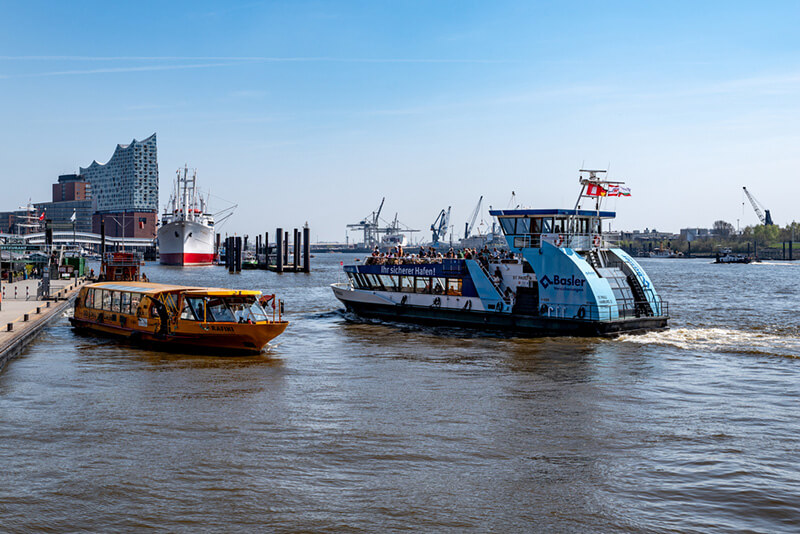
One of Hamburg’s most distinctive features is the integration of harbour ferries (HADAG) into the standard public transport network. These aren’t tourist cruises but genuine public transportation – though they certainly offer spectacular harbour views along the River Elbe.
Route: Landungsbrücken ↔ Finkenwerder.
Highlights: Passes the fish market, container terminals, and offers great views of the Elbphilharmonie.
Cost: Included in your standard HVV ticket!
Landungsbrücken Ferry Terminal:
Address: St. Pauli Hafenstraße 11, 20359 Hamburg
Connections: U3 U Bahn, S1/S3 S Bahn
Ten floating pontoons serving different routes
Digital displays show departing ferry numbers and destinations
Central location for harbour access
Did you know? HADAG has operated harbour ferries since 1888, making it one of Europe’s oldest continuous ferry services. The ferries carry approximately 14,000 passengers daily – roughly 40% commuters and 60% tourists crossing the River Elbe.
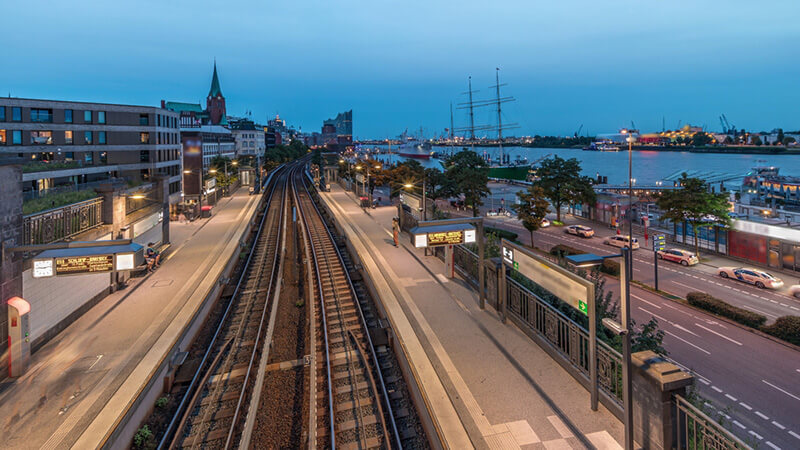
U Bahn and S Bahn:
Monday-Thursday: 04:30-00:30 (following morning)
Friday-Sunday: Continuous 24-hour service
This weekend pattern means that from early Friday morning through until late Sunday night, trains run without interruption – excellent for visitors planning evening activities.
Buses:
Standard routes: Typically 05:00 am – 11:00 pm (check schedule for specific routes)
MetroBus routes: Extended hours until 00:30 am
Night buses: Fill gaps 00:30-04:30 am Monday-Thursday with night buses running key routes
Ferries:
Monday-Friday: Approximately 06:00 am – 08:00 pm (varies by route)
Weekends: Reduced service (check schedule)
Hamburg is a very bike-friendly city, though the infrastructure can vary from dedicated bike highways to mixed traffic. The city is currently expanding its “Velorouten” (bike routes) network to connect the suburbs with the city centre.
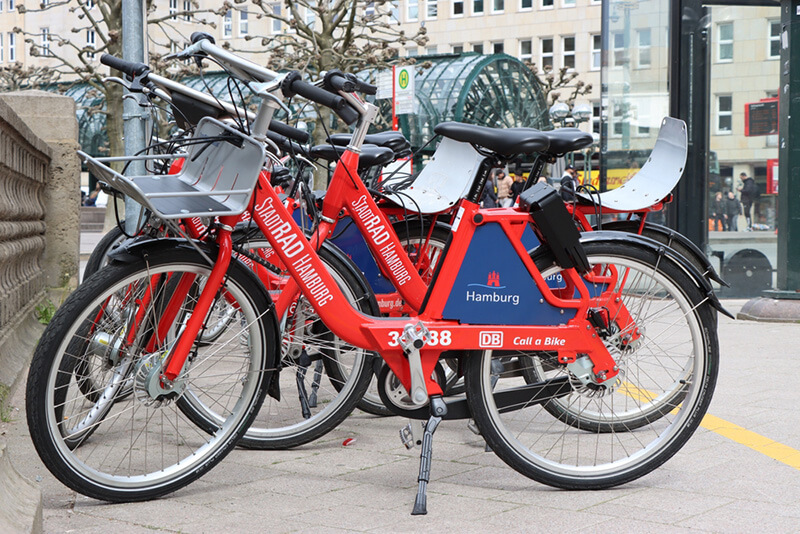
Unlike the fragmented market in some other cities, Hamburg has a dominant, city-subsidised bike-sharing system called StadtRAD Hamburg (operated by Deutsche Bahn).
How it works: You register via the app. You can unlock bikes at docking stations located all over the city (especially at U-Bahn and S-Bahn stations).
Pricing (The “30-Minute Rule”): This is the best feature. The first 30 minutes of every ride are free. From the 31st minute onwards, each additional minute costs 0,10€. If you have a valid HHV or BahnCard, the minute after the first 30 minutes is even cheaper and costs only 0,08€.
The Fleet: They offer standard city bikes and electric cargo bikes (Lastenpedelecs) which are great for grocery shopping or carrying children.
Sidewalks: Do not ride on the sidewalk (Gehweg) unless there is a sign saying “Radfahrer frei” (Cyclists free) or a painted bike lane on the sidewalk. Police in Hamburg frequently check this.
Public Transport: You can take bikes on the U-Bahn, S-Bahn, and HADAG Harbour Ferries for free, but not during rush hours (Mon-Fri 06:00–09:00 am and 04:00– 06:00 pm). Bikes are generally not allowed on buses.
A car is generally unnecessary for visitors staying in central Hamburg, as the public transportation system reaches all major attractions efficiently and parking can be expensive and challenging in the city centre.
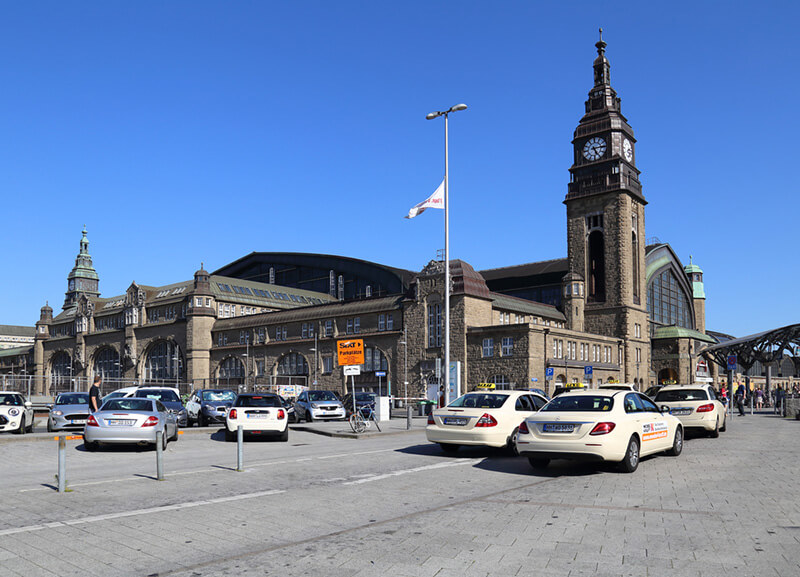
Hamburg has a high standard for taxi services, and unlike some cities where ride-share apps have taken over, the classic taxi remains very strong here.
Appearance: Cream/Ivory coloured (Elfenbein).
Hailing: You can hail them on the street if the yellow roof sign is lit. There are also many designated taxi stands (Taxistände) at airports, the Hauptbahnhof (Central Station), and Reeperbahn. Tip: If the taxi stand is empty, use the call pillar to summon a cab directly. Pressing the button connects you to the dispatch center for a quick pickup.
Payment: All Hamburg taxis must accept credit/debit cards by law. Cash is also fine.
FREENOW: This is the most popular app in Hamburg. It connects you to standard licensed taxis.
Uber / Bolt: These exist in Hamburg, but due to German regulations, they operate as “Mietwagen” (rental cars with drivers). They are generally cheaper than taxis but cannot use bus lanes (which taxis can), so they might be slower during rush hour.
This is unique to Hamburg (and Hanover) and is a crucial part of the transport mix.
What it is: An all-electric ride-pooling service. The vehicles are distinctive gold and black VW vans.
How it works: You book via the MOIA app. It is a “virtual bus stop” system. You walk to a nearby corner, the van picks you up, and it may pick up other passengers going in the same direction.
Cost: It is significantly cheaper than a taxi/Uber but slightly more expensive than a bus ticket. It is extremely comfortable (USB ports, fast WiFi, privacy seats).
Taxis: Operate on a meter. There is a base fee (approx. €4-€5) plus a per-kilometre charge.
Fixed Price: Recently, Hamburg introduced an option where you can agree on a fixed price if you book via an app, preventing meter anxiety.
Tipping: It is customary to round up or tip about 5-10%. For example, if the fare is €13.50, you might give €15.00.
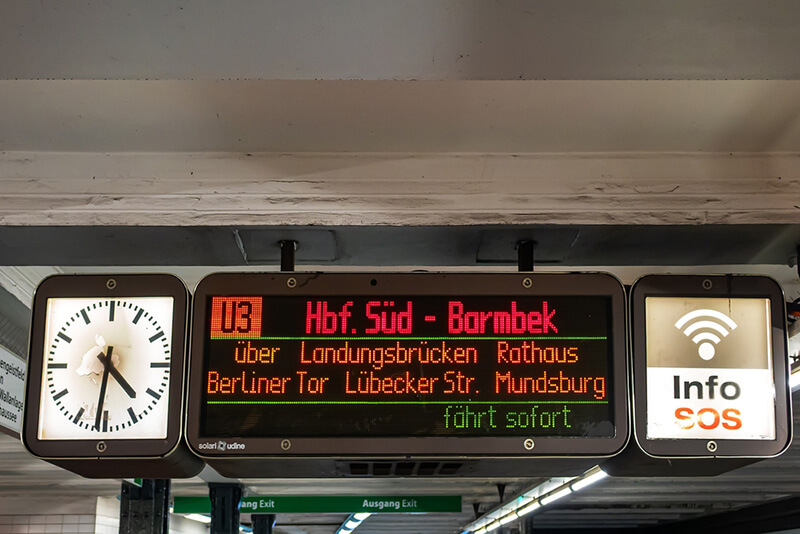
Find accommodation near a public transport stop.
Download the HVV App: It solves navigation challenges and eliminates the need for ticket machines.
Choose Your Ticket Wisely: If you are a group of 2-5 people, the Group Day Ticket is almost always cheaper than buying individual tickets.
U3 is Your Friend: The yellow line connects virtually all major tourist attractions.
Take Ferry 62: It offers spectacular harbour views using your standard ticket – no expensive harbour cruise required.
Weekend = 24-Hour Service: Friday and Saturday nights, trains run continuously, making late nights out simple.
Hamburg’s public transport network genuinely makes exploring this fascinating Hanseatic city straightforward and affordable. The integrated system means you’re never far from a connection, whether you’re heading to world-class museums like Miniatur Wunderland, the vibrant harbour, historic districts, or trendy neighbourhoods.
Download the HVV App, consider a prepurchased multiple-day ticket for ease of mind, and don’t miss experiencing the harbour ferries crossing the River Elbe – they’re public transportation that happens to offer spectacular views.
With this knowledge, you’re equipped to navigate public transport Hamburg confidently from the moment you arrive at Hamburg Airport. The city’s attractions await, and its efficient transport network ensures you’ll spend your time experiencing Hamburg rather than figuring out how to get around Hamburg.
Safe travels, and enjoy discovering everything this remarkable port city in Germany has to offer.